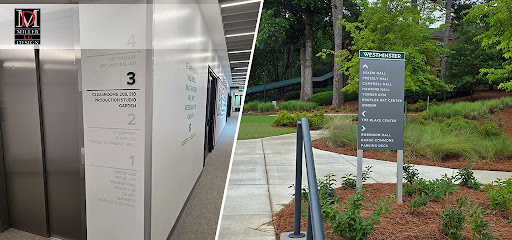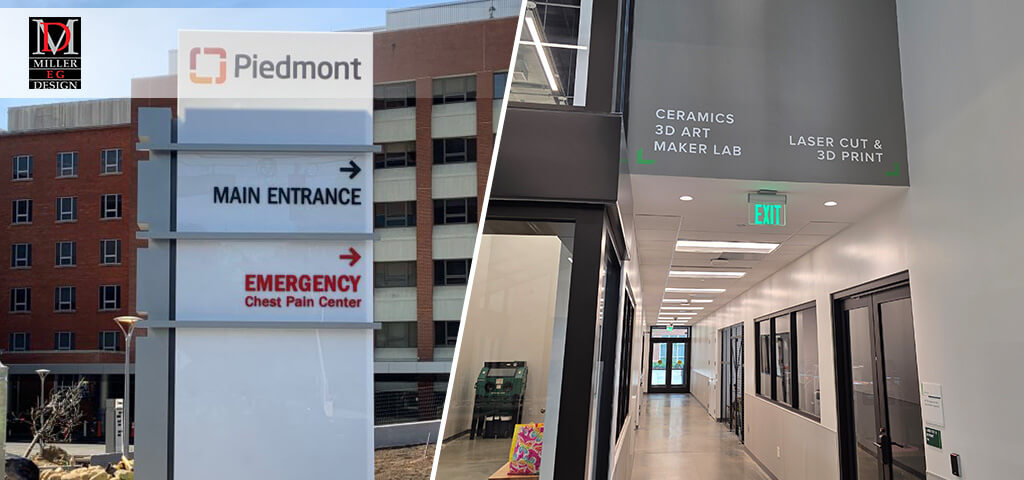
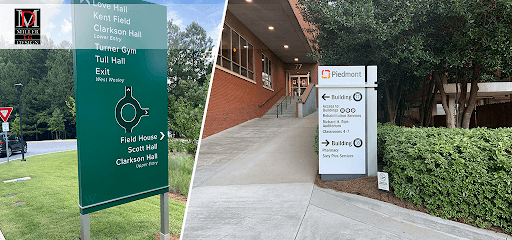
When someone walks into a commercial building, they should not have to stop and wonder where to go next. Finding a reception desk, office, restroom, elevator, department, or exit should feel natural. Yet in many buildings, confusing layouts and poorly planned signage turn a simple visit into a frustrating experience. The hidden cost of poor wayfinding design is not always immediately visible, but it can affect how people experience the entire property.
Wayfinding is more than putting arrows and signs on walls. It is a coordinated system that considers how people enter, move through, and understand a space. At Miller EG Design, we approach wayfinding as part of the overall environment, combining signage, facility maps, experiential graphics, and other visual cues to help people understand where they are and where they need to go.
Lost Visitors Can Mean Lost Opportunities
One of the most obvious consequences of poor wayfinding is visitor frustration. Imagine a prospective customer arriving for an appointment at a large office complex. They find the parking area but cannot determine which entrance to use. Once inside, they cannot find the reception area. After several wrong turns, they arrive late and frustrated.
That experience can influence how they view the organization, even when the actual service they came for is excellent.
The same issue can affect tenants, patients, students, employees, vendors, and guests. When people have difficulty finding their destinations, they may spend more time asking for directions or wandering through areas where they do not need to be.
Poor Wayfinding Can Increase Staff Demands
Confusing buildings often shift the burden of navigation onto employees. Receptionists, security personnel, customer service teams, and other staff members may repeatedly stop what they are doing to provide directions.
A single question may seem insignificant, but repeated throughout a busy commercial facility, these interruptions can consume valuable time.
A thoughtfully designed wayfinding system provides information before people reach the point where they need to ask for assistance. Directional signs, directories, maps, identification signs, and visual landmarks can work together to make navigation easier and reduce unnecessary questions.
Accessibility Should Be Part of the Design
Wayfinding also has an important accessibility component. Commercial buildings serve people with different abilities, levels of familiarity, and ways of processing information. Signs need to be placed thoughtfully, remain readable, and provide useful information at appropriate decision points.
Compliance considerations can also affect signage design, including requirements involving accessibility, placement, text, contrast, tactile elements, and other features. Addressing these considerations during planning can help avoid expensive changes later.
We believe compliance should be considered from the beginning rather than treated as something to address after the design is finished. Our work includes wayfinding consultation, custom signage development and management, code compliance, variance applications, and related design services.
Confusing Navigation Can Affect the Building Experience
A commercial building communicates something about the organization occupying it. Clean architecture, attractive interiors, and professional branding can lose some of their impact when visitors encounter inconsistent or confusing signs.
This is where experiential graphics can make a difference. Instead of treating signs as separate objects, experiential wayfinding integrates visual communication into the surrounding environment. Colors, typography, graphics, architectural features, maps, and signage can establish recognizable visual cues while supporting navigation.
For us, effective wayfinding is about creating a connected experience. People should be able to recognize where they are, understand what information matters, and make their next decision without unnecessary effort.
Planning Early Can Prevent Expensive Corrections
One of the most overlooked costs of poor wayfinding is having to fix it after a building is already occupied. Adding signs one at a time may address individual problems without solving the larger navigation system.
Planning wayfinding early allows us to study entrances, traffic patterns, decision points, destinations, sightlines, accessibility needs, and the relationship between signage and architecture. This helps create a consistent system rather than a collection of disconnected signs. Our process includes understanding the space and its users before developing the appropriate wayfinding strategy.
Ultimately, the hidden cost of poor wayfinding is measured in more than dollars. It can appear as wasted time, repeated questions, visitor frustration, accessibility challenges, unnecessary signage changes, and a disconnected customer experience. We help organizations address these issues through professional wayfinding design in Atlanta and surrounding areas. At Miller EG Design, located at 315 Northpoint Pkwy SE, Suite F, Acworth, GA 30102, we provide wayfinding consultation, custom signage, facility maps, experiential graphics, code compliance support, and comprehensive signage solutions designed around how people actually use a space. Contact us at (404) 947-6448 to discuss your commercial building or wayfinding project.