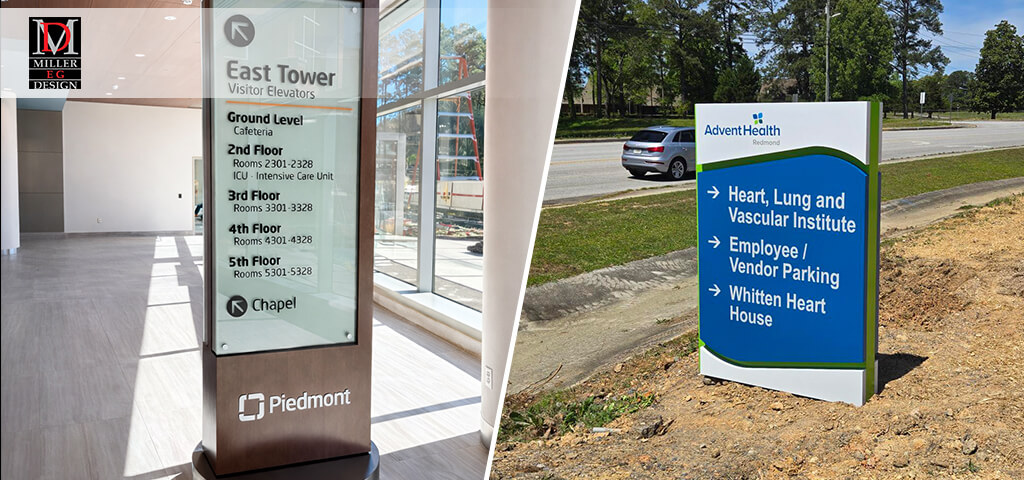
Have you ever walked into a large building and immediately wondered, “Where am I supposed to go?” Maybe there is a sign on the wall, but it does not quite answer your question. Or perhaps there are plenty of signs, yet the building still feels confusing.
That is where the difference between wayfinding design and standard signage becomes important.
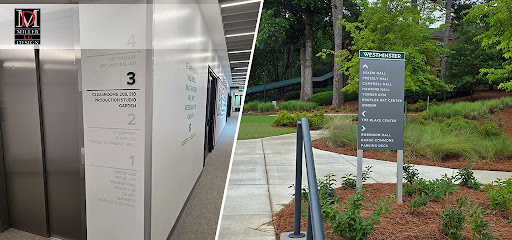
At Miller EG Design, we believe effective navigation is about more than putting directional signs around a property. Wayfinding considers how people actually move through a space and uses signage, graphics, maps, environmental cues, and visual communication to make that journey more intuitive.
What Is Standard Signage?
Standard signage generally has a straightforward purpose: communicate information.
A room identification sign tells you what room you are looking at. A restroom sign identifies a restroom. A directional sign may point toward an elevator, lobby, or parking area.
These signs are essential, and they can be highly effective when used correctly. However, individual signs typically address one specific communication need.
The challenge appears when a complex environment has dozens—or even hundreds—of individual signs that were designed separately.
Visitors may see information, but they may not understand how all of it connects.
What Makes Wayfinding Design Different?
Wayfinding looks at the entire navigation experience, rather than treating each sign as an isolated object.
We consider questions such as: Where does someone enter? What do they need to know first? Where will they need to make a decision? What destination are they trying to reach? What information should they see before they arrive at that decision point?
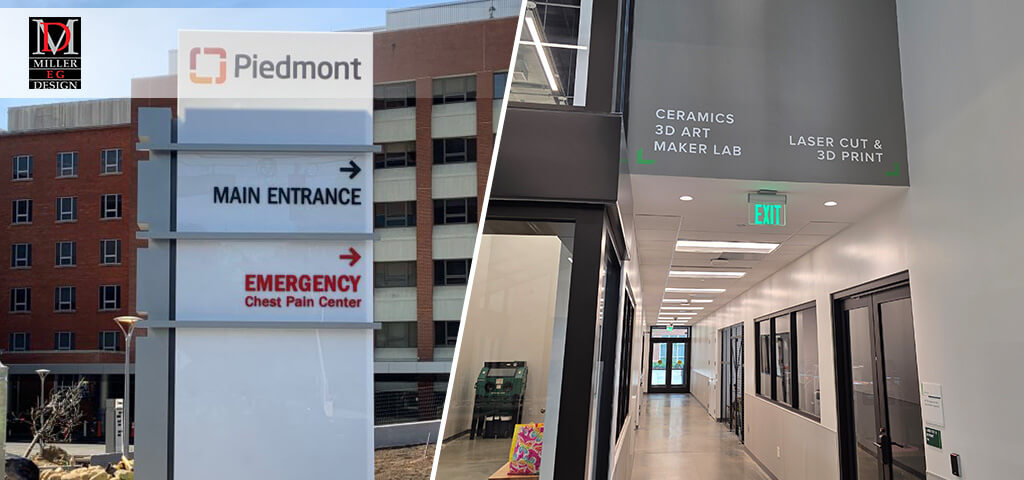
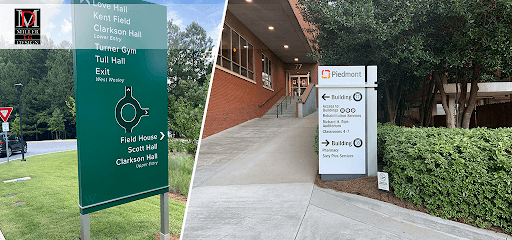
This approach can incorporate directional signs, facility maps, identification signs, color systems, symbols, architectural features, environmental graphics, and other visual cues.
The goal is simple: help people understand where they are, where they need to go, and how to get there.
Think of Wayfinding as a Conversation
One useful way to understand the difference is to think of signage as individual statements and wayfinding as a conversation.
A standard sign might say, “Emergency Department →.”
A wayfinding system asks what happens before and after that sign.
Did the visitor know which entrance to use? Could they recognize the correct corridor? Is the next directional cue easy to identify? Can they understand a facility map if they need one?
Good wayfinding creates a sequence of information that supports people throughout their journey rather than leaving them to piece together directions on their own.
Wayfinding Can Also Shape the Experience
Here is where wayfinding becomes more than navigation.
We can integrate signage and graphics with the surrounding architecture, visual identity, colors, typography, imagery, and other environmental elements. This helps signage feel like a natural part of the space instead of something added at the last minute.
For example, a healthcare facility may use clear, calming visual cues to make navigation less stressful. A university campus may use colors, landmarks, and environmental graphics to help visitors recognize different areas. A corporate environment may incorporate branded elements into its navigation system.
In each case, the design can communicate information while contributing to the overall character of the environment.
Why Facility Maps and Environmental Graphics Matter
Large or complicated properties often need more than arrows.
Facility maps can help visitors understand an entire environment and see how destinations relate to one another. Environmental graphics can create visual landmarks that help people remember where they are. Consistent symbols and colors can also reinforce information throughout a building or campus.
Together, these elements can make navigation feel more natural.
Instead of visitors repeatedly stopping to ask, “Where do I go?”, the environment itself provides helpful answers.
A Better Approach Starts Before the Sign Is Designed
Effective wayfinding does not begin with choosing a sign style. It begins with understanding the environment.
At Miller EG Design, our process can include research, analysis, concept development, testing, implementation, and evaluation. We look at the space, its users, circulation patterns, accessibility considerations, and communication needs before developing a coordinated solution.
That strategic approach is one of the biggest differences between simply ordering signs and developing a complete wayfinding system.
Which One Does Your Space Need?
Standard signage certainly has its place. But when visitors need to navigate a hospital, school, corporate campus, municipality, transportation facility, or other complex environment, a larger strategy may be necessary.
Wayfinding design connects the dots. It brings signage, facility maps, experiential graphics, environmental cues, and visual identity together to create a clearer and more cohesive experience.
If you are considering wayfinding design in Georgia, we can help you develop a system designed around how people actually use your space. At Miller EG Design, located at 315 Northpoint Pkwy SE, Suite F, Acworth, GA 30102, we provide wayfinding consultation, custom signage, experiential graphics, facility maps, corporate identification, and related design and implementation services. Call us at (404) 947-6448 to discuss your project.