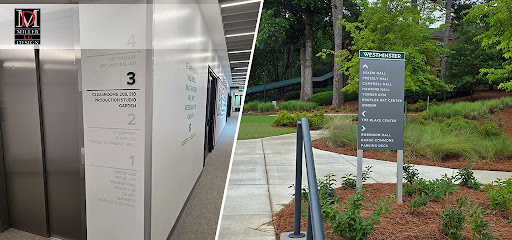
Walking into an unfamiliar building should not feel like solving a puzzle. Whether someone is visiting a hospital for the first time, looking for an office in a corporate complex, finding a classroom on a school campus, or locating a business in a commercial center, people need clear information to move confidently through a space. Wayfinding design provides that guidance.
Wayfinding is more than simply putting directional signs on walls. It is a strategic system that combines signage, maps, symbols, environmental graphics, architectural cues, and other visual elements to help people understand their surroundings and reach their destinations efficiently.
How Does Wayfinding Design Work?
Effective wayfinding begins by understanding how people actually move through a building or property. Designers consider entrances, exits, hallways, intersections, parking areas, elevators, stairways, important destinations, and other decision points.
The goal is to provide the right information at the right location.
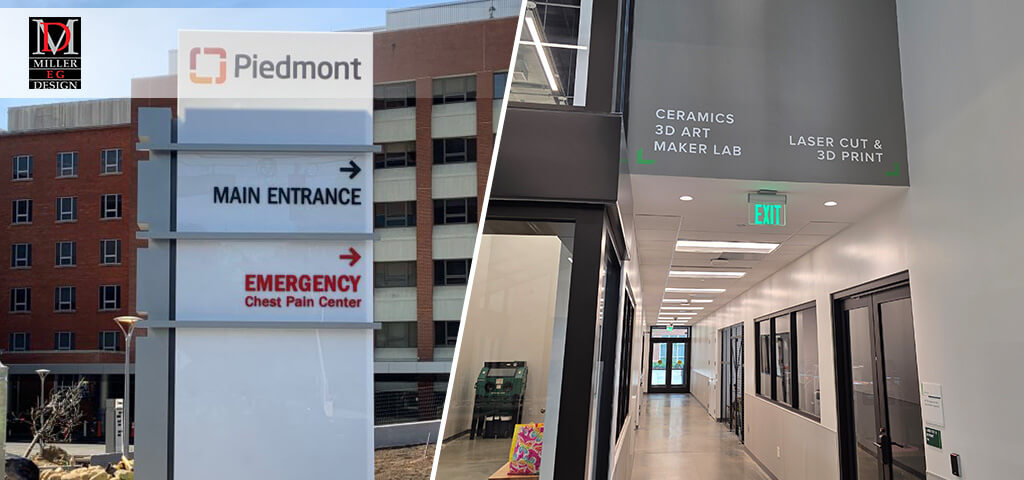
For example, someone entering a large medical facility may need to quickly identify the main lobby, registration area, specific departments, elevators, restrooms, and exits. A well-planned wayfinding system gives that person useful information before confusion occurs.
At Miller EG Design, we approach wayfinding as a complete experience rather than a collection of individual signs. Our process can include consultation, strategy, custom signage development, implementation, and ongoing support.
Why Does Every Building Need Wayfinding?
Not every building has the same navigation challenges, but almost every building has people who need to find their way through it. Effective wayfinding can provide several important benefits.
1. It Reduces Confusion
Poor navigation can make visitors feel frustrated and uncertain. When signs are missing, inconsistent, difficult to read, or placed in the wrong locations, people may have to stop and ask for directions.
A clear system provides visual guidance before visitors reach a point of uncertainty. Consistent signs, symbols, colors, maps, and directional information can make complex environments easier to understand.
2. It Improves the Visitor Experience
Wayfinding contributes to how people experience a building. A visitor who can quickly locate their destination is more likely to feel comfortable and confident.
This is especially important in environments where people may already be under stress, such as healthcare facilities. It also matters in corporate offices, educational campuses, retail properties, hospitality spaces, transportation facilities, and public buildings.
Good navigation quietly supports the user experience without becoming an obstacle itself.
3. It Supports Accessibility
Wayfinding should work for as many people as possible. Accessibility considerations can influence sign placement, readability, contrast, symbols, tactile information, and other design elements.
A thoughtful wayfinding system considers the different ways people interact with their environment. At Miller EG Design, accessibility is incorporated into our approach to creating user-centered navigation solutions.
4. It Strengthens a Building’s Identity
Wayfinding signs do not have to look like generic signs. They can become part of the overall design of a building.
Typography, colors, materials, graphics, and other visual elements can be coordinated with an organization’s brand and architecture. This creates a more cohesive environment while still keeping navigation clear.
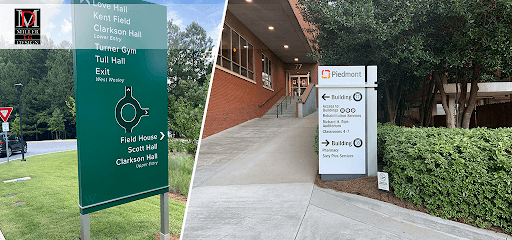
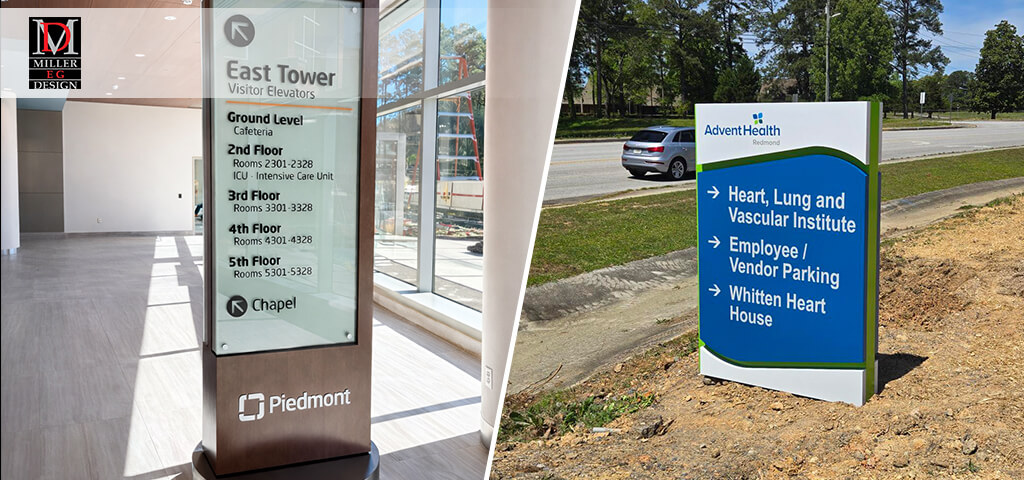
Our work in experiential graphics focuses on developing exterior and interior signage programs based on wayfinding information while integrating those elements into the surrounding environment.
Where Is Wayfinding Design Most Important?
Wayfinding can benefit virtually any environment where people need to navigate unfamiliar or complex spaces. Hospitals, healthcare facilities, universities, schools, corporate campuses, retail centers, government buildings, transportation facilities, and large commercial properties can all have significant navigation challenges.
The larger or more complicated the environment becomes, the more important it is to have a system rather than relying on individual signs added over time.
Why Should Wayfinding Be Planned Early?
Wayfinding works best when it is considered as part of a space’s overall design instead of being treated as an afterthought. Planning early allows designers to study traffic patterns, identify decision points, coordinate signage with architecture, address accessibility considerations, and create consistency throughout the property.
At Miller EG Design, we use a collaborative process involving research, analysis, concept development, testing, implementation, and evaluation. Our experience includes architectural, healthcare, educational, hospitality, transportation, corporate, and other environments.
How Can Miller EG Design Help With Wayfinding?
We believe better wayfinding begins with understanding people, spaces, and the purpose of each environment. Our team combines design strategy, signage, experiential graphics, facility maps, and implementation expertise to create functional, visually integrated navigation systems. We can help with wayfinding design in Atlanta and surrounding Metro Atlanta areas, serving organizations that need clearer, more intuitive spaces. Miller EG Design, located at 315 Northpoint Pkwy SE Suite F, Acworth, GA 30102, provides wayfinding consultation, custom signage, and experiential graphic solutions, along with related design and implementation services. To discuss your project with us, call (404) 947-6448.